
First-of-its-kind Australian Study Builds a Stronger Evidence Base for Circular Modular Housing

Using recycled content is important. But where are the opportunities to increase it, and what difference could those changes make? These are questions being asked by manufacturers, procurement teams, and government policymakers alike.
A first-of-its-kind Australian study commissioned by Homes NSW and undertaken by GECA set out to explore those questions, using a completed modular dwelling supplied by MOOV Modular as a real-world test case.
The Recycled Content Verification Study examined the dwelling’s material supply chain to establish a recycled-content baseline, assess the quality of supporting evidence, benchmark priority materials against Australian and international practice, and identify opportunities for future improvement. Rebuilt provided the embodied-carbon analysis, allowing the study to also explore how changes in recycled content could influence upfront carbon emissions.
The result is a practical evidence base for understanding not only how much recycled content is currently being used, but also how confidently those claims can be substantiated and where procurement can help drive better outcomes.
From claims to procurement-ready evidence
Recycled-content figures are becoming increasingly common in supplier sustainability information. But the study found that the evidence sitting behind those figures can vary significantly.
A reported percentage might apply to a specific product, for example, or it could represent an average across a manufacturing line or an entire site. Environmental Product Declarations (EPDs), supplier declarations, certifications, production records and chain-of-custody information also vary in their ability to substantiate product-level claims.
For major buyers, that distinction matters.
Reliable and comparable evidence is needed to establish meaningful baselines, set future requirements, measure progress and make confident procurement decisions.
To build that evidence base, GECA combined Australian and international research with project-specific supply-chain analysis. The study reviewed more than 100 sources, mapped more than 20 material categories across the dwelling supply chain and assessed six priority material streams in detail.
What did the study find?
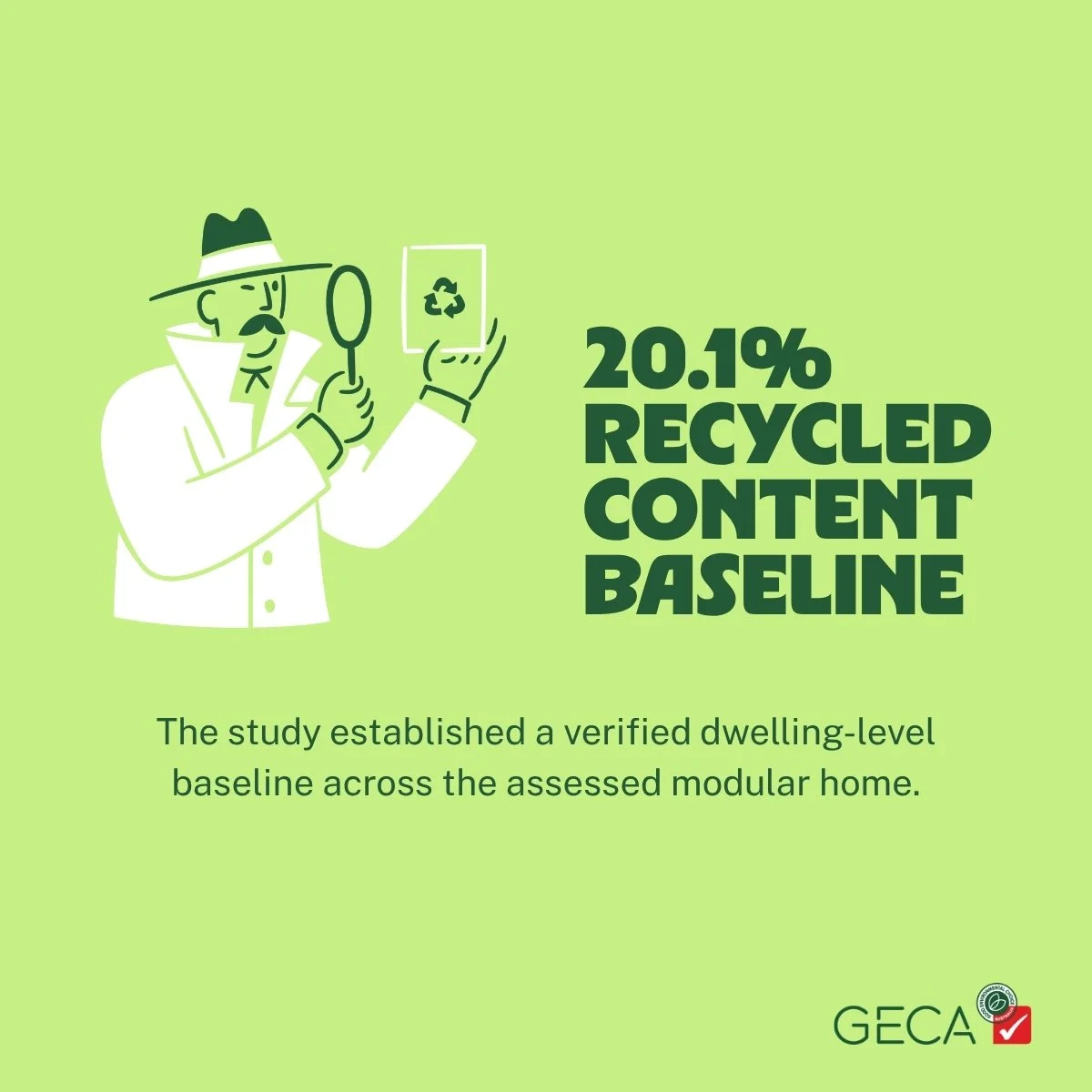
The assessment established a verified dwelling-level recycled-content baseline of 20.1% by weight across 94.15% of mapped dwelling weight.
The dwelling’s upfront embodied-carbon footprint was assessed at 382.3 kgCO₂e/m² for lifecycle stages A1–A3. Modelling found that increasing recycled content across the six priority materials could reduce upfront embodied carbon by up to around 10% under the scenarios assessed.
But one of the most important findings is that recycled content and embodied carbon are connected without being interchangeable.
The materials offering the greatest opportunity to increase recycled content are not necessarily those offering the greatest carbon reductions. Structural steel illustrates this particularly clearly: the production route can have a greater influence on carbon outcomes than increasing recycled content alone within conventional steelmaking.
This reinforces the need to look beyond a single sustainability metric and consider each material in the context of its manufacturing processes, supply chain and available evidence. It also shows that measuring carbon alone doesn’t give you the full picture of how you are improving outcomes.
Different materials need different strategies
The study assessed structural steel, aluminium, plasterboard, engineered wood, insulation and composite decking in detail.
The opportunities varied significantly.
Aluminium and plasterboard showed some of the largest gaps between the assessed baseline and global best practice, while insulation and composite decking were already much closer to leading performance. Structural steel and engineered wood presented different challenges again, shaped by production technologies, market maturity and the availability of robust verification evidence.
That means there is no single recycled-content percentage that makes sense across every construction material.
Instead, the study recommends a material-by-material approach, using realistic benchmarks and progressively strengthening both recycled-content requirements and the evidence needed to substantiate them.
Government procurement is a powerful driver of change
One of the clearest findings from the study is the influence government procurement can have on the market.
Through its purchasing requirements, government can send a strong signal to suppliers — encouraging greater use of recycled content, stronger evidence behind environmental claims and investment in the systems needed to support more circular outcomes.
The opportunity is therefore not simply to ask suppliers for higher recycled-content percentages. Procurement requirements can also strengthen the quality, transparency and verification of the evidence behind those figures.
The study recommends building recycled-content and carbon evidence requirements into procurement from the outset, setting requirements at tender stage and progressively increasing expectations over time as markets and supplier capabilities mature. It also found that greater consistency across agencies and jurisdictions is more likely to give industry the confidence to invest and respond.
The analysis also found that procurement leverage is concentrated among a relatively small number of manufacturers supplying significant material categories, meaning targeted engagement with strategic, high-volume suppliers may achieve greater impact than pursuing isolated product substitutions across the broader supply chain.
For GECA, this is an important part of moving from claims to evidence to procurement-ready information — using government purchasing power not only to increase demand for recycled materials, but to help create the conditions for more transparent and circular supply chains.
From one pilot to a stronger evidence base
The recommendations arising from the project extend well beyond the recycled-content percentage itself.
They include building evidence and verification requirements into procurement early, tracking both recycled-content performance and the confidence of supporting evidence, setting targets material by material, prioritising strategic suppliers and progressively strengthening requirements as markets mature.
The methodology was developed as a pilot that could be progressively applied across additional modular housing suppliers and projects, helping to build a stronger evidence base over time.
The value of the project therefore extends beyond a single dwelling.
It provides a practical example of how evidence, independent assessment and procurement can work together to support more consistent, transparent and circular housing outcomes.
"Building more homes faster has to go hand in hand with building them sustainably. By putting a completed modular home under the microscope, this study offers practical lessons not just for Homes NSW, but for anyone procuring housing at scale in Australia," says Rose Ung, Homes NSW Delivery Director for MMC.
"Recycled content is already delivering benefits, and this study shows there is real room to go further. It identifies immediate opportunities for improvement, practical pathways forward and, importantly, the need to verify the evidence behind recycled-content claims," says GECA CEO Josh Begbie.
Explore the findings: Read the case study.