
Why Verified Recycled Content Matters More Than Ever

The rise of circular economy thinking is reshaping how products are designed, manufactured, procured and reported on across Australia. Governments, businesses and consumers increasingly recognise that using recycled materials is essential to reducing waste, conserving virgin resources, and supporting domestic material recovery.
But as recycled content claims become more common, one critical question is emerging:
How do we know if those claims are accurate?
The era of vague or unsubstantiated recycled content claims is rapidly coming to an end. Procurement teams, regulators and consumers are demanding greater transparency, traceability and accountability, and rightly so.
For circular economy goals to succeed, recycled content claims must be credible, measurable, and independently verified.
Recycled Content Is No Longer Enough on Its Own
Using recycled materials remains an important step in shifting our economy from linear to circular. Keeping materials in use for longer helps divert waste from landfill, reduce pressure on virgin resource extraction, minimise pollution and support more sustainable manufacturing systems.
Research continues to show strong public support for recycled products, while governments across Australia are embedding circular economy principles into procurement and infrastructure policies. Public sector buyers are increasingly seeking ways to prioritise products that support resource recovery and measurable sustainability outcomes. Increasingly, procurement teams also need credible data to support ESG reporting, policy compliance and public accountability.
However, the market has matured significantly in recent years.
Today, the challenge is no longer simply encouraging the uptake of recycled content; it is ensuring recycled content claims are transparent, comparable, and trustworthy.
Too often, recycled content information is:
self-declared
inconsistent
difficult to compare
unsupported by evidence
This creates risk for businesses, confusion for consumers, and significant challenges for procurement teams attempting to measure and report on circularity outcomes.
Without credible data, circular economy goals become difficult to measure and even harder to achieve.
The Growing Scrutiny Around Environmental Claims
The Australian Competition and Consumer Commission (ACCC) has made it clear that businesses must ensure environmental claims are accurate, specific and evidence-based.
This includes recycled content claims.
At GECA, we know that what businesses exclude from a claim can be just as meaningful, or misleading, as what they include. For example, claiming that a product is “made from recycled plastic” without disclosing how much recycled material is actually present, or what other virgin materials are included, risks creating a misleading overall impression.
That is why GECA requires that recycled content claims include verified evidence to clearly disclose:
the percentage of recycled content
whether the content is pre-consumer or post-consumer
whether the recycled content was sourced from Australia or overseas
Independent verification is increasingly becoming the benchmark for credibility.
In fact, the NSW Recycled Content Reporting Guide specifically notes that independently verified claims are preferable to self-declared claims for scoring and reporting purposes and should be used whenever possible.
Why Verification Matters
Verified recycled content data creates confidence across the supply chain, from procurement teams and governments to manufacturers and consumers.
Third-party verification also helps reduce greenwashing risk, improve stakeholder trust and future-proof supply chains.
Importantly, verification creates consistency and comparability. When claims are measured consistently and supported by evidence, procurement teams can make more informed decisions and track progress over time.
As governments increasingly integrate circular economy requirements into procurement frameworks, access to verified and traceable data will become increasingly important.
Circular Procurement Requires Better Data
Procurement teams play a critical role in growing Australia’s circular economy.
By specifying independently verified recycled content requirements, procurement can help:
drive demand for recovered materials
encourage more sustainable manufacturing
support innovation
create stronger business cases for circular products
improve reporting transparency
Yet many procurement teams still face a major challenge: the lack of accessible, scalable and affordable verification systems.
This creates a cycle of inertia:
suppliers don’t pursue verification because procurement doesn’t consistently reward it
procurement teams struggle to compare inconsistent and unverified claims
governments cannot confidently measure impact
Breaking that cycle requires practical, scalable solutions.
A New Era of Recycled Content Verification
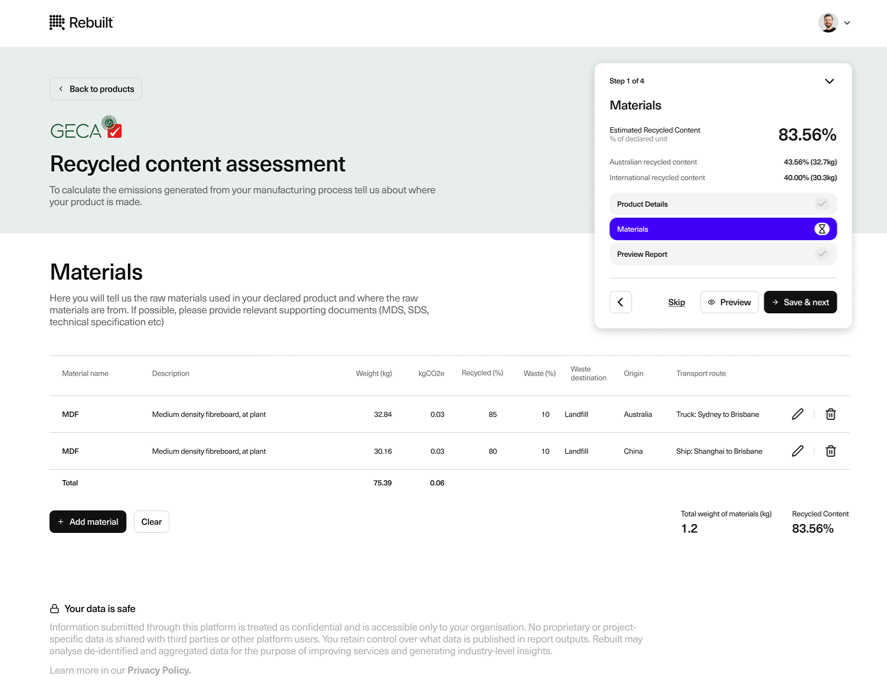
To help address this challenge, GECA and Rebuilt have created a new Recycled Content Verification (RCV) tool designed to support transparent circular procurement through trusted, third-party verified data.
Powered by Rebuilt’s award-winning platform and independently verified by GECA, the RCV tool provides an accessible pathway for organisations to substantiate recycled content claims with traceable evidence.
The tool enables businesses to:
upload recycled material evidence and documentation
ensure that evidence is fit-for-purpose, and change it if not
receive independent third-party verification
obtain verified breakdowns of recycled content percentages
correctly distinguish between pre-consumer and post-consumer content
support procurement and reporting requirements with credible data
Importantly, the solution has been designed to reduce the cost, complexity and accessibility barriers that have historically limited recycled content verification.
The RCV tool also aligns with:
ISO 14021 principles
NSW recycled content reporting requirements
broader circular procurement objectives
Learn more about how the RCV tool can support transparent circular procurement and credible recycled-content claims.
Moving Beyond Claims to a Holistic Approach
At GECA, we also recognise that recycled content, while valuable, is only one part of the sustainability picture.
Not all products containing recycled content are automatically sustainable.
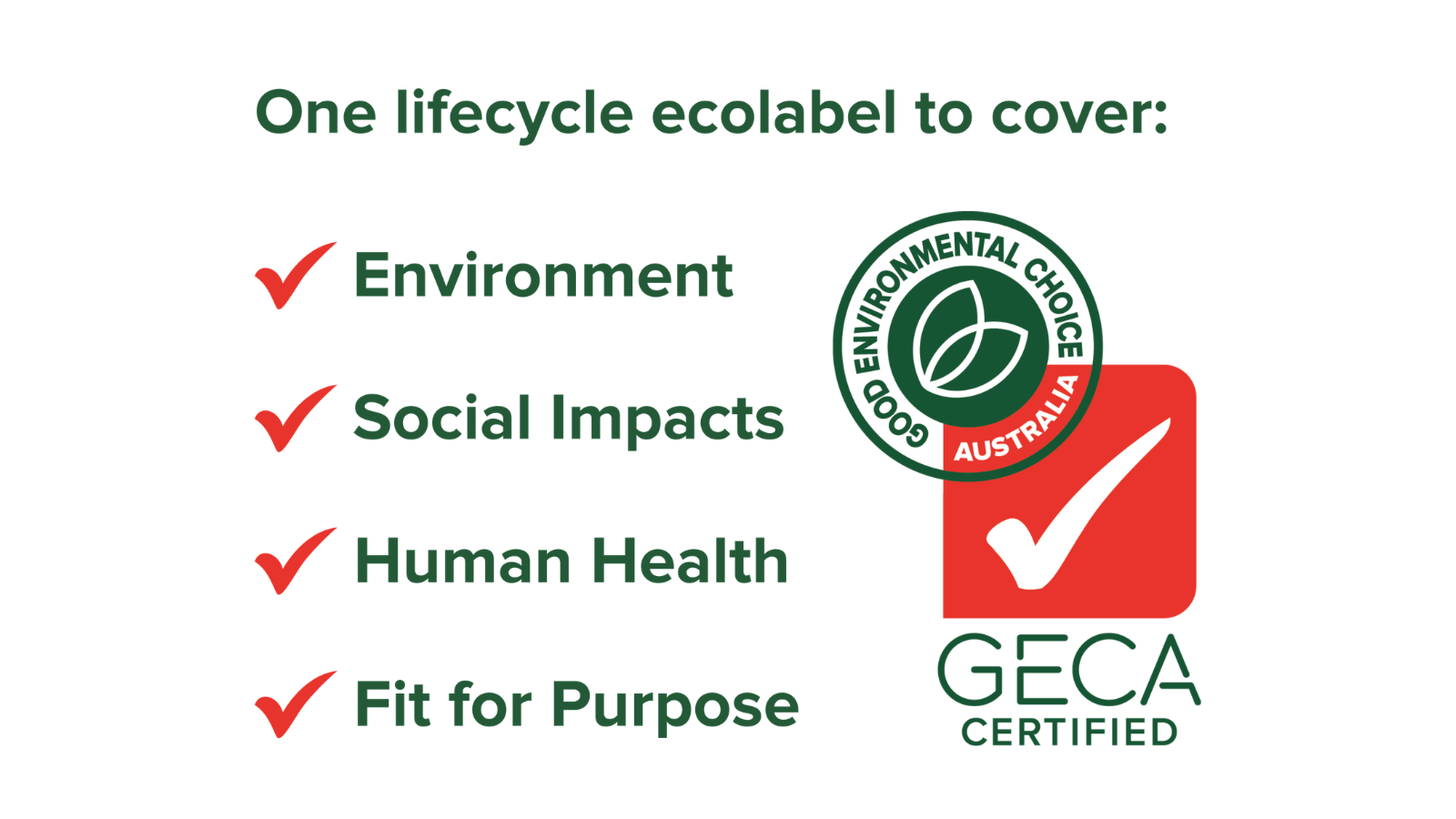
While the RCV tool focuses specifically on verifying recycled content claims, GECA’s Recycled Products standard takes a broader lifecycle approach. The standard assesses recycled products against a wide range of environmental, human health, social and fit-for-purpose criteria to help identify products that are a better overall sustainability choice.
Together, these complementary approaches help organisations demonstrate both credible recycled content claims and broader sustainability leadership.
In addition to recycled content, GECA certified recycled products are assessed against criteria relating to:
hazardous substances
emissions
packaging and end-of-life stewardship
waste management
modern slavery reporting
workplace safety
fitness for purpose
This broader lifecycle approach helps ensure that products are not only made with recycled materials but also genuinely contribute to better outcomes for people and planet.
An example of this holistic approach to recycled content is our licensee, TRUEGRID, which offers an environmentally sustainable alternative to the negative impacts associated with traditional hardstand materials like concrete and asphalt.
According to their case study, “Certifying our permeable pavers under GECA’s Recycled Products standard is integral to TRUEGRID’s operations, particularly in a market where technical certification is often a prerequisite for project approval. TRUEGRID’s GECA certification is prominently featured in our marketing efforts, assuring potential clients that our products meet stringent environmental, human health, social impact and quality criteria.”
Discover more about our Recycled Products standard here.
Transparency Will Define the Future of Circularity
Carbon transparency changed markets.
Recycled content transparency will do the same.
As circular economy expectations continue to evolve, businesses that can provide credible, verified and traceable sustainability data will be better positioned to:
meet procurement requirements
reduce greenwashing risk
strengthen stakeholder trust
demonstrate leadership
support measurable circular economy outcomes
The future of recycled content claims will not be built on marketing language.
It will be built on credible, verified evidence.